A moon lander game with six worlds and a tower at the end
Most rocket games stop at the launch. Rocket Landing: Moon Lander starts where the classic lunar lander started — a ship falling toward a surface, an engine, a fuel gauge, and a pad you have to hit — and then keeps going. Six worlds, each with its own gravity, wind and fuel burn. A tower at the end that takes the pad away. One mission a day that every pilot on Earth flies against the same wind.
It is free, plays fully offline, and asks for no signup. If you want to try the genre before you install anything, our separate free browser lander at tool.teamzlab.com/games/moon-lander/ has a Moon pad and a drone ship.
The lunar landing, world by world
The lander game you remember from the arcade had one trick: gravity pulls, thrust pushes, fuel runs out, and the pad is the only safe place to stop. Every lander game since has been a riff on that trick.
This one keeps the trick and changes the conditions on every world. It is an arcade game, not a flight simulator — gravity, drag, wind and fuel burn are tuned per world for play, not copied from real spacecraft:
- The Moon — Shackleton. No atmosphere and a lighter fall than Earth, but the engine drinks fuel three times as fast, and the first engine flame-outs start here. Fuel is the whole problem.
- Mars — Jezero. Thin air, just enough drag to lie to you, and dust storms that push you off-line the whole way down.
- Titan. Thick atmosphere, slow descents, everything happens late. The patience world.
- Europa. Barely any wind, but the engine cuts out more often than on any other world, every cut drops you faster, and a lopsided nozzle keeps nudging you sideways.
- Earth — Boca Chica. Full gravity, wind, fog, night descents. The teaching world, and the place you learn the catch.
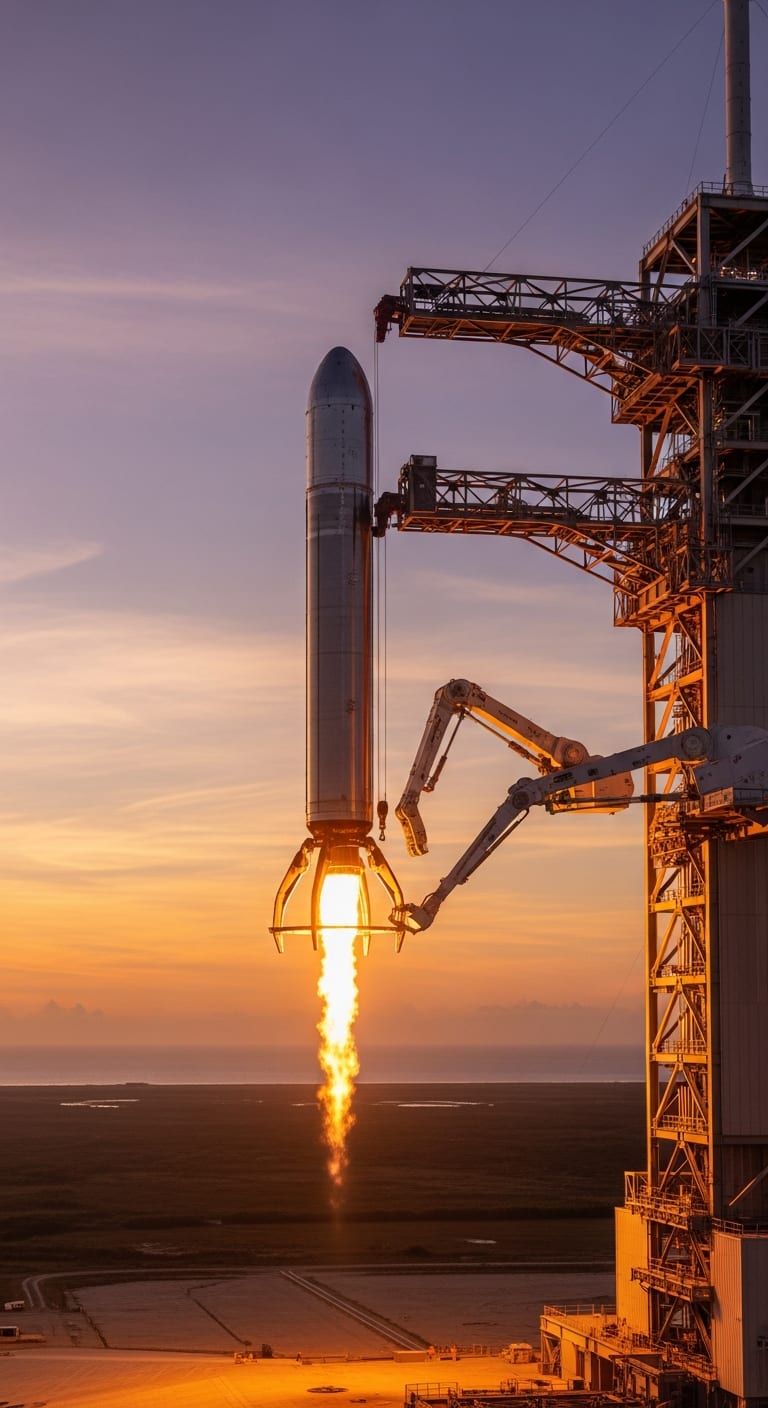
- The Mechazilla arc. No pad at all. A Super Heavy booster has to arrive inside a pair of chopstick arms.
You will feel the difference the first time the wind walks you off the centreline on the way down and the ship comes down beside the pad instead of on it. The game tells you exactly what happened — the crash cause, the second it went wrong, the altitude and fuel you had left — in a letter you will want to send to someone.
”Rocket landing game” — which landing are you actually after?
People search rocket landing game meaning four quite different descents, and it is worth knowing which one you came for, because each asks something different of you.
- A pad landing with no atmosphere. The classic lunar lander: Shackleton on the Moon, no air, and an engine that eats fuel fast. This is the one most people picture, and it is where our separate free browser lander starts you.
- A pad landing with atmosphere fighting you. Mars gives you thin air and dust storms, Titan gives you thick drag and slow descents, Europa gives you an engine that keeps cutting out. Same rule, three different lies.
- A drone-ship landing at sea. The Falcon-style recovery onto a small floating pad. There is still a surface under you, so putting your engine down on the pad’s centre is the whole job — the gentlest way into the genre after the Moon.
- A tower catch with no pad at all. A Super Heavy booster has to arrive inside a pair of chopstick arms, through the gustiest wind in the game. This is the hardest descent in the game and the one the Mechazilla arc is built around.
All four are in Rocket Landing: Moon Lander, free, offline and without a signup. If you want to try the genre before installing anything, our separate free browser lander has a Moon pad and a drone ship; the tower catch, the six worlds and the daily global mission are in the app. Our other games are on the games page.
Today’s global mission — same pad, same wind, every pilot on Earth
The mechanic the whole game is built around: today, every pilot in the world flies the same mission. Same pad, same wind speed, same fuel margin, same fog. Three stars on the line. Crash and you can go again; land it and that landing is your result for the day. Online, the debrief tells you what percentage of today’s pilots you out-scored.
You do not fly it alone. Online, a ghost of a real rival’s recorded descent flies beside you — not a bot, another pilot’s actual run on today’s mission, picked from pilots who scored a little above your recent best. When they pull ahead at thirty metres you can see exactly what they did that you did not. Offline, the ghost is your own best run.
The share card is spoiler-free — an emoji grid, like a daily word puzzle, no result given away. Send it to the group chat, send your pilot code so friends can join, and watch the streak anxiety set in. The mission resets at midnight, local time.
How to land cleanly — what the three stars measure
New pilots crash the same way: they leave the drift until it is too late to fix and come down beside the pad. On a career mission, stars come from one landing grade — S, A, B or C — set by how close to the centre of the pad your engine touches down. Landing with under a quarter of the tank, or after 85% of the time limit, drops the grade by one each. S is three stars, A is two, B or C is one. The daily mission turns the same landing into points — time, fuel left and the grade all count — and gives its three stars from those.
- Kill the drift early. Wind pushes you sideways the whole way down. Correct it high, while you still have time to fix it, not in the last seconds when one more correction can carry you past the pad.
- Do not burn the fuel margin early. Every input fires the engine and costs fuel. Landing with under a quarter of the tank drops a grade, and an empty tank ends the run, so steer in short corrections instead of constant ones.
- Watch the centre, not the speed. The pad does not check how fast you arrive; it checks where. The landing counts only if your engine drops inside the pad’s inner ring, and the closer to the centre, the better the grade.
- Pick the control scheme honestly. Tilt (the motion sensor) gives finer drift control once your hands learn it; tap is more predictable under pressure. If a phone sends no motion-sensor data, the game falls back to tap on its own, and tap clears every world.
- Learn the worlds in order. Earth teaches the approach. The Moon takes the air away and makes fuel the problem. Mars adds dust-storm gusts and a wind that switches sides. Titan slows everything down. Europa keeps cutting your engine. You have to clear them in order anyway — the Moon opens at rank Pilot, after the 13 Earth missions.
- Your first landing is gentler on purpose. Until you land once, M01 widens the pad and slows the final approach. It switches off the moment you land, and nothing after it gets that help.
Starship landing or Falcon-style drone ship — two recoveries, two skills
People arrive here from two searches. Some typed falcon 9 landing and want the drone-ship recovery they have watched a hundred times. Some typed starship landing and want the tower. The game has both, and they are not the same skill.
- Drone-ship landing — the Falcon-style recovery. Your booster comes back to a floating pad at sea. The pad is small and it moves, but it is still a pad: there is a surface under you, and putting your engine down on its centre is the whole job.
- Tower catch — the Super Heavy recovery. No pad. Your booster has to arrive inside a pair of chopstick arms, through the strongest gusts in the game and a wind that flips sides every few seconds. The Mechazilla arc is this recovery, and it is the one that decides whether the rank on your Pilot Card means anything.
The practical difference: on the tower, your fuel goes on fighting drift. The landing check is the same as on a pad — your engine has to drop inside the target’s inner ring — but the tower world has the strongest gusts in the game. Arriving too fast never costs you the catch; drifting off the centreline does, and the arms close on nothing.
What the vehicles are. The boosters in this game are ours, not licensed models. “Falcon-style” is a slim single-stick booster and “Super Heavy” a large one; you choose the ship you fly in the hangar, and it changes the look, not the landing. The game is tuned for play; nothing here simulates any real rocket’s flight software or telemetry, and the game is not affiliated with SpaceX.
”Catch the booster” — the game mode, and how the catch is actually scored
If you came here looking for a catch the booster game — the one where the rocket comes back to the tower and two arms close on it instead of legs touching a pad — that is the Mechazilla arc, and it is a full world, not a bonus level.
Here is what the catch asks of you, in order:
- Arrive on the centreline, not near it. Your engine has to drop inside the inner ring at the centre of the arms; outside it the run is a crash, and inside it the closer you are to the centre, the better the grade. How fast you arrive is not checked — where you arrive is everything.
- Kill the drift high. Correcting early leaves time to settle; correcting in the last seconds tends to carry you past the arms. The wind pushes you off-line the whole way down — and in the Mechazilla arc it flips sides every few seconds — so the correction is continuous, not a single input.
- Hold the fuel margin. Every correction burns fuel. Finish with under a quarter of the tank and the grade drops by one; run the tank dry and the catch is over before the arms.
Where to learn it: Earth (Boca Chica) teaches the catch with wind, fog and night descents while the stakes are low. The Mechazilla arc is where it decides your rank. If you want the pad version first, the drone-ship recovery above is the gentler teacher — and our separate free browser lander at tool.teamzlab.com/games/moon-lander/ has a Moon pad and a drone ship, though the tower catch itself lives in the app.
More of our games are on the games page, and the wider app catalogue is on the Teamz Lab apps home.
Eight vehicles, five ranks, commanders with faces
Every world cleared moves you up the rank: Cadet → Pilot → Commander → Ace → Legend. Each rank brings a new commander — most have portraits now — who briefs your missions and, when you crash, reads your worst landing back to you on the debrief card. Your Pilot Card is a one-page, screenshot-ready record of every world you have cleared and every rank you have earned. Built to be sent.
The hangar holds eight vehicles: a Falcon-style booster, Falcon Heavy, Starship, Super Heavy, a crew capsule, a lunar lander, a heavy booster, and a Mars hopper. Four fly free from the start; Falcon Heavy and the heavy booster are bought with credits you earn by landing missions and from the daily pay calendar; Super Heavy and the crew capsule come with the Captain’s Bundle. The ship changes how your rocket looks, not how it lands — every mission plays the same in any of them, so pick the one you like.
Come back tomorrow — the loop a lander game never had
The classic lander was a high-score reset. This one has a week in it.
- Daily pay calendar on the Home screen: seven tiles, today claimable on a tap, tomorrow’s already showing what it pays.
- Flight Week: seven seeded dailies form a named week. Land five of the seven and the week pays out a cosmetic booster trail.
- Quick Run: a sixty-second random Earth descent, one tap from the hero card, for when you have one minute and not five.
- Mission Map visible from day one: all six worlds, the locked ones telling you exactly what opens them.
Every crash writes you an email — the Apology Letter to Elon
You do not just crash. The game composes an Apology Letter to Elon, formatted like a real email — your mission, the attempt number, the crash cause, the second it went wrong, and the altitude and fuel you had left.
Six deadpan mission-control styles, all of them shareable — made for the group chat, where a friend sees theirs and wants to know what their own would say.
Free, offline, no paywall — and how we keep it that way
Rocket Landing: Moon Lander is free to download and free to play. No forced subscription. No signup. No account. Every world, every rank, every mission and the daily global mission play fully offline — the real-rival ghost and the daily percentile appear when you are online.
The game is ad-supported (standard banner and interstitial ads between runs from Google AdMob) with optional rewarded ads for extra fuel and retries — never forced. The one paid item is the Captain’s Bundle, a single one-time purchase that removes ads, unlocks every current rocket skin and adds two bundle-only vehicles (Super Heavy and the crew capsule) to the hangar. If you never buy it, every world, mission and rank is still yours.
Pilot Card progress and rank history are saved on your device, and also to your Play Games or Game Center account when you are signed in. A daily landing made online sends your score and a short flight trace under a random pilot ID — no name or account — for the percentile and the rival ghosts. See our Privacy Policy for the full data summary.
How it compares to other lander and rocket games
- The arcade lunar lander and its browser clones. One pad, one gravity, one high score. This game keeps the rule — fight gravity, land on the pad before the fuel runs out — and adds five more worlds, a tower with no pad, a daily mission and a rival. If you only want the classic, a Moon pad plays free in our separate browser lander at tool.teamzlab.com/games/moon-lander/.
- Spaceflight Simulator. An excellent open-ended rocket builder — design and orbit. This is the other half of the loop: the rocket is built, the orbit is done, the only thing left is the descent. Short sessions, mobile-first, daily mission.
- Kerbal Space Program. The genre’s grandparent. Deep, sandbox, desktop-first. We are not trying to be KSP on a phone — we are the 60-second lander loop KSP fans pull up between meetings.
- Generic “rocket launch” arcade games. Tap-to-launch, no physics, no landing. This game leads with the landing — the only part of a launch stream everyone actually holds their breath for.
Who it is for
- Anyone who played a lunar lander game once and still remembers the exact feeling of drifting past the pad with the fuel gauge on empty.
- Launch-stream watchers who wanted a phone version of the tower catch the moment the arms closed for the first time.
- Spaceflight Simulator and KSP fans who love the build but want a five-minute descent loop too.
- Daily-puzzle players who want one shared mission a day with a shareable result card and a real rival.
The real catch the tower arc is built on
On 13 October 2024, SpaceX flew a Super Heavy booster back to its launch tower at Starbase in Boca Chica and caught it in the tower’s two articulated arms — the first time a returning orbital-class booster was caught by a tower instead of setting down on legs. That descent is the moment the Mechazilla arc is built around.
What the game takes from it, and what it does not:
- The lateral problem is the real problem. A tower catch has no pad to aim at, so sideways error is what decides it. That is why centring sets your landing grade and why wind pushes you off-line the entire way down.
- Fuel is the constraint that decides everything. Every correction burns propellant, an empty tank ends the run, and finishing with under a quarter of the tank costs a grade.
- What it is not. An independent arcade game, not a simulation of any real vehicle’s flight software, telemetry or engine performance, and not affiliated with, sponsored by, or endorsed by SpaceX. The numbers are tuned for play, and the booster is ours.
Built by Teamz Lab — and available for hire
Rocket Landing: Moon Lander is built in Flutter by Teamz Lab, a small UK studio. The same team ships DeviceGPT (phone diagnostics), No Trace Chat, Phosphor, and Toss — shipped work is on our portfolio and the people behind it are on the team page. If it is another of our games you want rather than another of our apps, Arrow Jam 3D is the 3D logic puzzle and Kintsugi Pottery: Goldmend is the pottery game — throw clay, let the kiln crack it, then mend the break with gold. The poker trainer is a free browser prototype that scores your Texas Hold’em decisions and explains the better line, if you want something to think about rather than something to fly.
If you want a custom mobile game, a physics or simulation app, or a polished cross-platform Flutter build for your own brand, we take client work through our Upwork agency profile — milestone escrow, so money moves only when you approve the deliverable. Start with our app development service if you are scoping a build from scratch.
Bottom line: If you want a moon lander game with somewhere to go after the Moon — six worlds, a Starship tower catch, one global mission a day, a real rival, and an Apology Letter on every crash — install Rocket Landing: Moon Lander from the buttons on this page. Free, offline, no signup. Three stars on the line, every day.