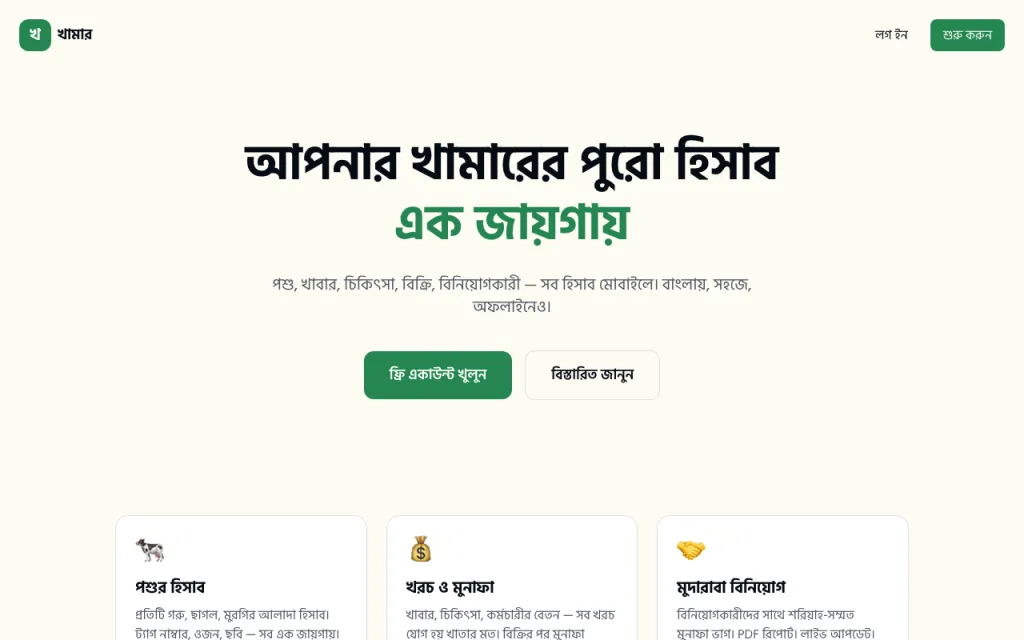
Farm management software for Bangladesh livestock farms
Farm management software replaces the paper khata with one set of digital records for animals, feed, health, sales and money. Khamar (খামার) does this for livestock farms in Bangladesh: Bangla-first, laid out for a phone, and able to work out cost and profit per animal and to share that profit with investors under Mudaraba or Musharaka rules.
Who it is for
Khamar is for owners of cattle, goat, poultry, dairy and fish farms who currently keep their books in a notebook, a spreadsheet or a stream of messages, and for the managers who do the daily work. It is also for farm owners who raise money from investors, because the investor side is the part few farm tools handle. There are six roles: farm owner, farm manager, investor, para-vet, dealer and platform admin, each with its own landing screen.
Every animal, every batch
Each animal has a record: a tag number, where it came from (bought or born on the farm), a weight log, photos, a status such as active, sold, dead or sacrificed, and a place in a family tree. A new farm starts with Cow, Goat and Chicken categories, and you can add your own, such as ducks, so the list is not fixed. Poultry can be tracked as a batch (a flock) instead of one by one. Dairy and breeding farms get records for pregnancy, lactation and heat, and every death is logged with a cause so you can see mortality over time.
Feed, health, milk and eggs
Feed items have stock levels and suppliers. Feed can be allocated per animal, per batch, or in proportion to weight, and the cost of what was fed lands on the right animals. Treatments cover vaccines, medicines and vet visits, and vaccine schedules are stored per category. Milk can be entered the quick way, total litres and total taka for the day with today’s date filled in, or per cow. Egg collection works out the price per piece for you. Medicines, vets and workers (with salary payments) each have their own lists.
Dairy and goat farm management
For a dairy farm the daily numbers are milk, feed and health. Milk goes in per cow or as a farm total for the day, and you can add the fat % and SNF if your buyer pays by quality. Each cow has a lactation record with a running total, a pregnancy record that works out the expected calving date from the insemination date, and the next expected heat on her page. When you enter a withdrawal period (in days) for a medicine, the animal shows the date until which its milk or meat should not be sold, and a sale during a meat withdrawal is blocked unless you override it, which is recorded in the audit log. Profit per cow counts milk income as well as the sale.
A goat farm uses the same records. Goat is one of the default categories on a new farm, and for it the pregnancy record uses a 150-day gestation instead of a cow’s 280, so the expected kidding date comes out right. Before Eid, the weight log and the Qurbani calculator below do most of the selling work.
Cost, profit and a fair price
Cost per animal adds the purchase price, feed, treatment and an allocated share of overheads. When an animal is sold, the profit is the sale minus that cost. Sales record the buyer and track what is paid and what is still owed, and loans and payables have their own pages. The reports page exports a farm profit and loss as a PDF and an Excel file.
For Qurbani season there is a fair-price calculator. It converts live weight to Mon (40 kg), multiplies by the current rate, adds a beauty premium, and can suggest a minimum sale price from the animal’s real cost plus the margin you want. You can pick one of your animals from a list and the weight fills in.
Mudaraba and Musharaka investors
Most farm software has no answer for the investor who puts money into an animal and expects a share of the result. Khamar does. The owner records the investor’s principal, either against specific animals or against the whole farm, and picks the loss rule: the Mudaraba default, where the capital provider bears financial loss and the farmer loses only labour, or Musharaka, where both partners share loss in proportion to capital.
The investor logs in to a read-only portal that shows their principal, their live profit share and a PDF statement. The rules in the code are simple and strict: principal is never counted as profit, and a payout cannot exceed the profit accrued. This follows the structure of those contracts, but it has not been certified by a Sharia board, so run your actual contract terms past your own advisor.
Fisheries and the wider network
Pond farmers get their own module: ponds, species, water-quality readings such as pH and dissolved oxygen, activity logs, biomass estimates, feed conversion and the financials of a pond. A para-vet or feed dealer can use a multi-farm dashboard to look after the farms they serve, and a referral code on sign-up credits the provider a Tk 50 commission.
Built for a phone, in Bangla
The interface is Bangla-first, with an English toggle. Tap targets are large, and there are four colour themes, including a high-contrast one for sunlight. A farm manager does not get the full books. They get a short screen of picture buttons for the day: fed, vaccinated, weighed, milked, eggs collected.
What it does not do
Khamar is not crop-farming software, it does not read IoT sensors, and it is not a marketplace that finds you buyers. It needs an internet connection to save records. It can be added to a phone home screen, but entries made without signal are not queued for later. Plan prices are not quoted on this page.
Try it
Open Khamar and create a free account with your mobile number. Start with a handful of animals and a few days of feed and milk records, and check the cost and profit views before you move your whole farm over.
Khamar is built by Teamz Lab. If you need something like it for a different livestock market or a different industry, that is work we take on through Upwork, where payment sits in escrow until you accept each milestone.