What mock interview practice is for
Mock interview practice means rehearsing a real interview before the day: hearing a question, answering it out loud, and getting feedback you can act on. Bussinly runs that practice on your phone. You pick a role, speak one answer at a time, and get a score, a verdict and three specific fixes.
It exists for the part of interview preparation that reading a list of questions never covers: saying the answer, in order, without freezing.
Most interview preparation is passive. You read common questions, nod at the model answers, and feel ready. Then the real interview starts and the first thing you notice is that you have never actually said any of it. The words come out slower or faster than you thought, there are more fillers than you expected, and the structure you had in your head falls apart halfway through. A mock interview you speak exposes those problems while they are still cheap to fix.
Choosing the interview
You can browse by industry and department, search a job title, or use the role already in your profile, and the questions follow the title you pick. That matters because a generic question list prepares you for a generic interviewer, and nobody has one of those.
Voice is the main mode. Text mode exists for the times you cannot speak, such as on a train or in a shared room, so you can still work on what you would say. Each mock interview counts against your allowance when it starts, not when the setup screen opens, so browsing the options costs nothing.
While you speak
During a voice answer the screen shows your delivery as it happens: your pace in words per minute, your filler words and a fluency reading, alongside a live waveform. The fluency figure is calculated the same way as the final score, so the meter you watch and the result you get do not contradict each other. The app uses your phone’s speech recognition to follow what you say, and it asks for microphone access for that.
What you get back
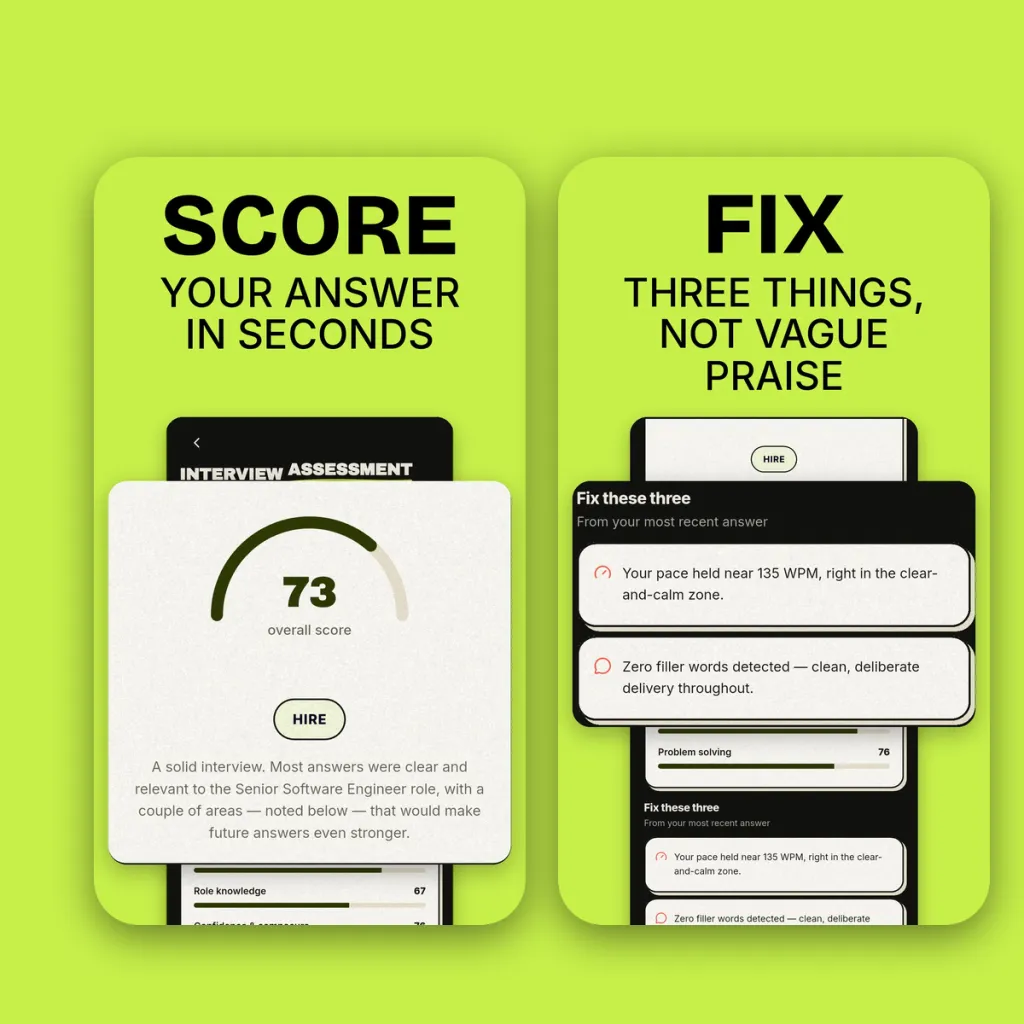
When the session ends you get an overall score and a verdict that runs from Strong Hire through Hire and Lean Hire to No Hire. It is worth knowing exactly how that score is made, because it is rule-based, not an AI reading your answer. Delivery comes from your pace and your filler words. Content comes from how long your answers are and whether they include numbers or results and action verbs such as led, built or improved. Pace, filler words and fluency are reported alongside. The score does not check whether what you said is right for the job, so treat it as a measure of how you delivered the answer, and judge the substance yourself.
Then comes the part that makes the practice useful: a section called Fix these three. It is built from your most recent answer and covers three things: pace, filler words and content. If you ran fast it says so and gives you a target of 110 to 150 words per minute. If you used filler words it counts them and suggests swapping each for a one-second pause. If the answer was short or had no measurable result, it tells you to add the context, the action and the result. Three things is the point. A long list of notes is easy to read and impossible to act on before the next attempt.
Then you run it again. Your interviews are saved in a history, and the home screen shows a readiness score and a practice streak, so you can see whether the number is actually moving. A passing interview score earns a certificate.
Practising the conversations around the interview
An interview is one hard conversation among several. Difficult Conversations is a set of practice scenarios, not advice articles. Each scenario gives you a real workplace situation as the question, you answer it by voice or text, and the answer is scored the same way as an interview. The packs include giving hard feedback, performance conversations, holding the line, and saying no and meaning it, plus a pack of classic behavioural interview stories such as disagreeing with a manager or talking about a project that failed.
Around that sit a few things you may or may not need. Short job-skills courses with lessons you can finish on a commute, and certificates when you complete them; the short written answers in those courses are marked by an AI model against a rubric. Everyday and workplace English speaking practice, useful if English is your second language and the interview is two problems at once. A CV builder with templates, so your CV and your interview stories can tell the same story. The whole app runs in English and Bangla.
A simple week of practice
If the interview is a week away, a few short sessions beat one long one. Run one mock interview early to find out where you stand, and read the three fixes rather than the score. Work on those three things for a day or two, then run a second session for the same role and compare. Use the last days on the questions you answered worst, out loud, until the structure holds without notes. Two free sessions a month cover the first and the last of those; a busier run-up is what the Interview Sprint is for.
What it costs
The free plan includes two mock interviews a month, which is enough to see how the app works and, in the app’s own words, not enough to get good at it. Past that you have two ways to unlock unlimited interviews. Premium is monthly and renews until you cancel. The Interview Sprint is one payment that covers three months, ends on its own and does not auto-renew, and you can add your interview date so the app tells you whether the pass will cover it. Both are bought inside the app.
What it is not
Bussinly is not a human coach. No person reviews your answers, and nothing here guarantees a job offer. A score tells you how an answer did on pace, filler words, length and specific detail, not how a particular employer will judge what you said. It also does not teach salary negotiation, so look elsewhere for that. What it does is give you a safe place to say the answer badly, see exactly why, and say it better the next time.