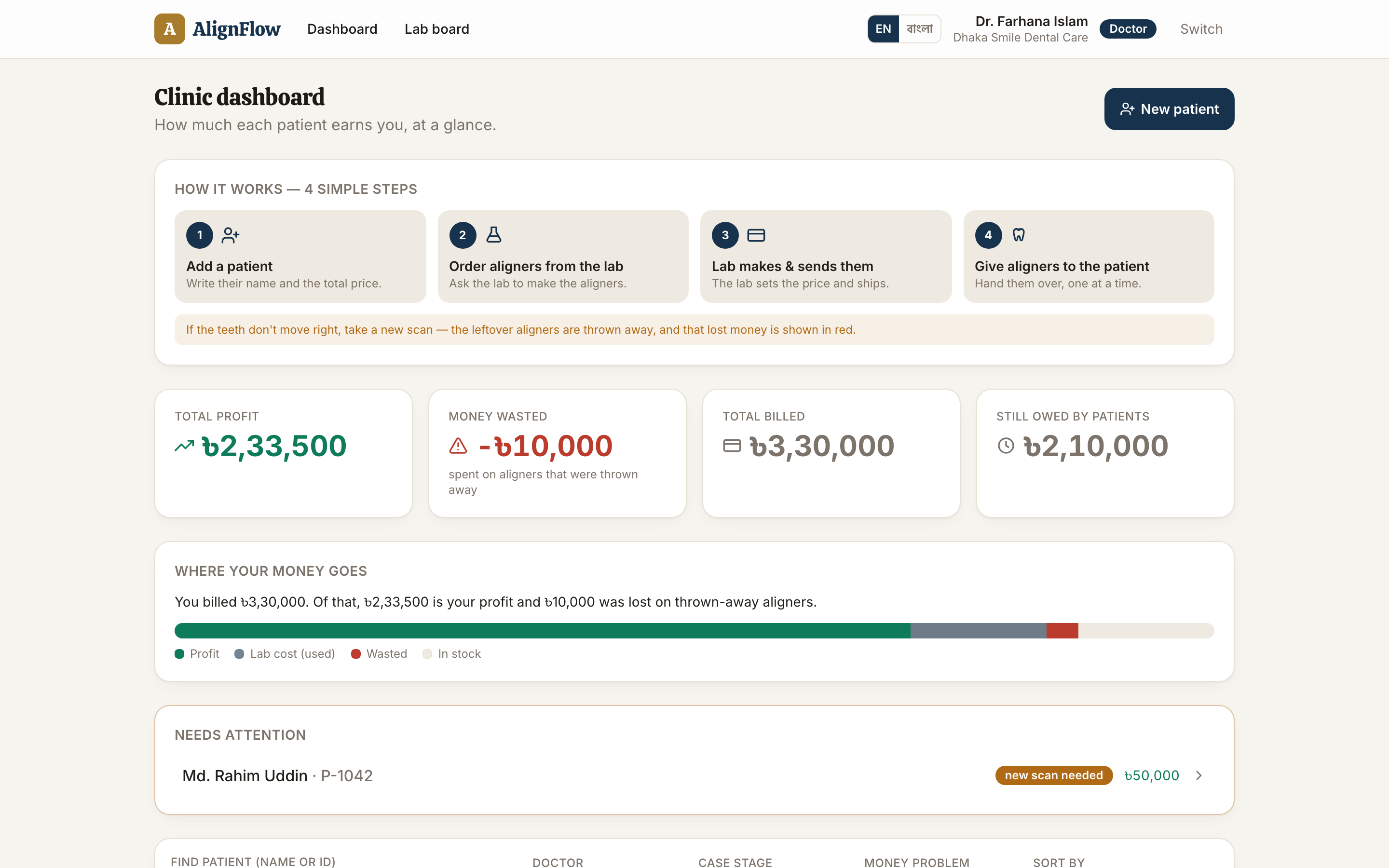
Modular dental practice management — strongest where it matters
Most dental software forces a choice: a heavy legacy practice-management suite (expensive, clunky, built for the US) or a single-purpose tool that does one thing. AlignFlow is modular. Switch on General Practice for the daily essentials, switch on the Clear-Aligner module for aligner economics, or run both. You pay for what you use, and staff only ever see the modules their clinic has enabled — so the software never overwhelms a non-technical dentist.
Underneath, every module shares one patient record. Add a patient when you book an appointment and they are ready for a treatment plan, a prescription, an invoice, or an aligner case — with a single history, no duplicate data entry.
The feature that grows your clinic: the patient portal
The hardest part of running a clinic is keeping patients engaged between visits. AlignFlow’s answer is a passwordless patient portal. Staff tap “Share with patient,” pick what to show, and send a secure link over WhatsApp. The patient opens it on their phone and sees their treatment progress, next appointment, and amount due — with no app, no account, and no login.
The link is high-entropy, scope-limited, view-only, and expires on its own; a leaked link shows almost nothing and can be revoked instantly. Patients forward it to family, which is exactly the word-of-mouth that grows a clinic for free. No other dental tool in this market makes patient updates this frictionless.
The daily essentials, done simply
General Practice covers what a clinic touches every day:
- Appointments — book, track, and complete visits.
- Patient records & history — one shared record with a clinical-notes timeline.
- Dental charting — tooth-by-tooth findings and treatments (FDI numbering).
- Periodontal — dated exams with pocket depths and bleeding.
- Prescriptions — multi-drug Rx with dose, frequency, and duration.
- Imaging & files — attach X-rays, photos, and documents to the patient.
- Inventory — clinic supply stock with low-stock flags.
- Manual billing — invoices and cash / bKash / bank payments, paid-versus-due per invoice.
A deliberate, honest scope: billing is manual — there is no card-payment gateway, because clinics here collect in cash, bKash, or bank transfer, and a gateway only adds fees and friction. There is no insurance module, because the insurance-billing workflow that bloats Western dental software does not exist in this market.
The clear-aligner module: see the margin you actually keep
Aligner cases lose money in two invisible ways — refinements that scrap undelivered trays, and corrections bundled into a flat fee. AlignFlow makes both visible. Every plan has a contract price; every received lab order books a real cost; every refinement and case-close writes off the scrapped trays. The dashboard shows live per-patient margin after that waste — contract price − real lab cost − write-offs. It is the number a quote can never give you, and the reason an aligner clinic chooses AlignFlow.
It is the operations and money layer, not aligner CAD — pair it with ArchForm, uLab, or whatever you design in. Orders flow across a production board, and a many-to-many lab network lets a clinic use several labs and a lab serve several clinics, with labs seeing only a non-identifying case reference behind a patient-data firewall.
Built for Bangladesh and South Asia
AlignFlow is bilingual English / বাংলা, priced in taka, multi-clinic, and multi-tenant with a platform-owner console. The language, the money, the manual billing, and the WhatsApp-first patient portal all assume how clinics and labs in this region actually work — not a US workflow with the prices and the gateways swapped out.
What you are actually choosing between
Buying dental software in this market is not a feature comparison, it is a choice between three shapes of product, and the features only matter after you have picked the shape.
A legacy Western practice-management suite — Dentrix, Open Dental, CareStack, Dolphin and the rest — is twenty years deep. Everything you can think of is in there somewhere, along with a large amount you will never use: insurance claim workflows for a system Bangladesh does not have, card-gateway billing for payments your patients make in cash or bKash, and an interface designed for a receptionist who has been trained on it. The cost is not only the licence. It is the training time, the English-only screens, and the fact that nobody in the building can change anything.
A single-purpose tool — an aligner planner, a booking widget, a billing app — is cheap and immediately useful, and then you own three of them, none of which share a patient record, so somebody re-types the same person into each.
AlignFlow is the third shape: one shared patient record underneath, and modules you switch on. Run General Practice alone and it is an appointments-records-charting-prescriptions-billing system with a patient portal. Add the Clear-Aligner module and the same patients gain treatment plans, batch lab orders, refinement write-offs, and live per-patient margin. Nothing is re-entered, and staff never see a screen for a module the clinic has not enabled.
Where it deliberately does less: no insurance module, no card gateway, and no aligner CAD. Those are not gaps waiting to be filled — the first two do not apply here, and the third is a different category of software you should keep using alongside this.
Built by Teamz Lab — and we build this kind of system for other industries
AlignFlow is our own product, not a client case study we are allowed to mention. It is here as proof of a specific competence: multi-tenant SaaS where several businesses share a platform but must never see each other’s data, with real cost and margin tracking, role-based access, a bilingual interface, and a patient-data firewall between the parties.
That shape is not specific to dentistry. The same architecture is what a diagnostic lab, a physiotherapy chain, a veterinary group, a repair workshop, or any two-sided operations business needs. If you are a founder or a clinic owner who wants something like this built, the honest starting points are MVP app development for non-technical founders if the product does not exist yet, hire an app developer for a startup if it does and you need it moved forward, and AI for business if the expensive part is the manual back-office work rather than the software itself.
We take that work through Teamz Lab on Upwork, where payment sits in escrow until you accept the milestone. For a first engagement with a team you have not worked with, that protection matters more than any portfolio page.
Try the live demo — sign in and look around
AlignFlow is live, no signup wall. Open the live demo and sign in as a clinic doctor with [email protected] / demo1234 to see the dashboard, patients, appointments, aligner cases, and live margin. The demo is seeded with real cases, a connected in-house lab, an independent lab (Bright Labs BD), cross-clinic orders, clinical records, and a working patient-portal link — so every role has something to look at.
If you run a dental clinic or lab in Bangladesh or South Asia and you want modern, modular, affordable software that finally puts your patients and your aligner margin in one place, AlignFlow is built for that.