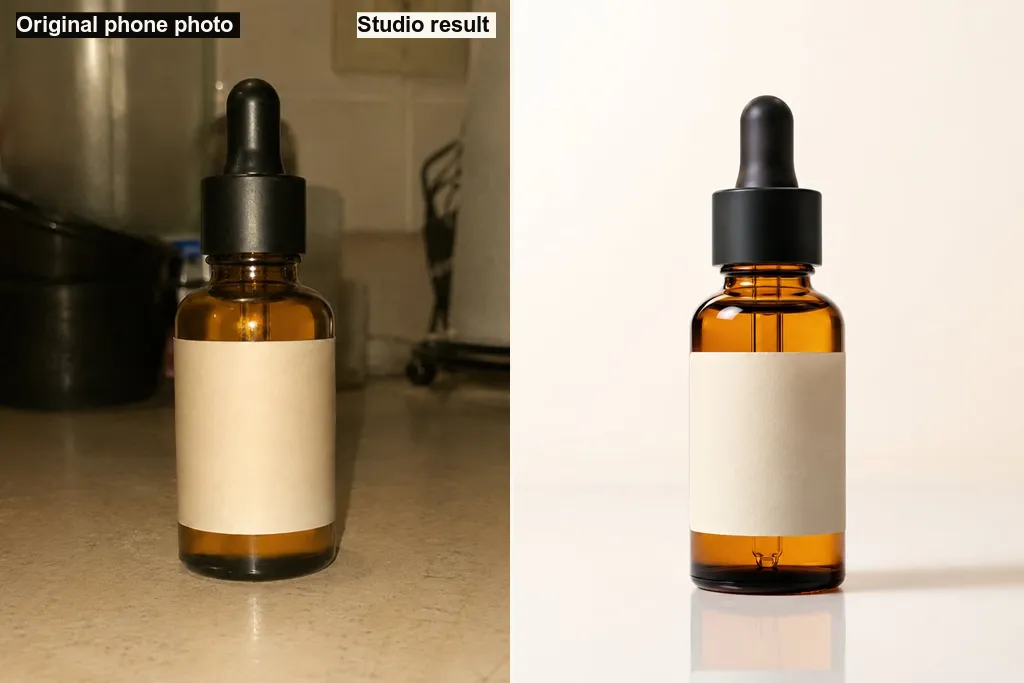
What is an AI product image generator, and which one tries to keep your product true?
An AI product image generator turns a photo of a product into listing images. AI Product Studio does this from one phone photo: you say what you sell and where you will post, and it makes white-background, studio, lifestyle and on-model shots while a Product Lock tells the model to keep your product’s colour, shape, logo and material unchanged.
Most AI image tools are built to make a beautiful picture. A seller needs something different: a believable picture of the exact thing the customer will receive. If the colour shifts, a logo melts or a chain bends, the photo sells a product that does not exist, and the cost shows up later as returns and one-star reviews. AI Product Studio is built around that problem: your real product is the thing it tries hardest not to change.
Two questions, then one photo
The setup is deliberately short. You answer two questions and the studio tailors everything after that.
- What are you selling? There are 17 categories, from jewelry, clothing and shoes to beauty, electronics, furniture, food and drink, toys, pet products and handmade items. The category decides which scenes make sense. A ring suits a close-up or an on-hand shot, a mug suits a table, and a sofa suits a room.
- Where will you post it? Etsy, Shopify, Amazon, Instagram, Facebook, or just clean photos. This decides the shots and the export sizes. In the Bangladesh view, Daraz, WhatsApp catalog and Bikroy replace the global marketplaces, and Eid and Pohela Boishakh scenes are offered.
Then you upload one photo. A plain phone photo is fine, and the tool suggests a simple background and good light because a clear original gives the model less to guess.
Product Lock: choose what must not change
The part most tools skip is the lock. Before you generate, you pick what has to stay exactly the same: colour, shape, logo and text, and material. You also pick how strict to be. Loose allows more creative scenes and lets the product shift a little, Balanced keeps shape and proportions, and Strict tells the model to treat the product as a fixed object it may only re-light and re-stage.
Under the hood the lock becomes explicit instructions to the image model. Instructions are not enforcement, which is why the fidelity check below exists, but the lock is the reason this product is not just a prompt box in a nicer wrapper.
A fidelity check on your results
Instructions are not proof, so in the Guided single-photo studio and the On a model studio each generated photo is also measured against your original. The check looks at colour drift in the product region, how much the silhouette overlaps the original, and whether fine detail such as logos and edges survived or went soft. A result that looks fine on all three is marked as true to your product. One that drifted is flagged with a short reason, and you can make a new variation or keep it if it looks right to you.
Be clear about what this is. It is a safeguard that catches the common failures, not a guarantee, and scenes where the product legitimately moves, such as lifestyle and on-model shots, are judged more loosely on shape. The one-tap Quick tab and Bulk clean-up do not run this check, so look at those photos closely before you list them.
What you can make
- Marketplace sets. White-background main images, studio and lifestyle scenes, close-ups and packaging shots, sized for the channel you picked.
- On-model clothing photos. Add a photo of your garment and either a photo of a person or a ready model look. The studio says plainly that clothing can need one retry.
- Your logo and a sale badge. Upload a PNG logo and add a badge such as SALE, NEW or BESTSELLER. These are placed on the finished photo by the app, not drawn by the AI, so they stay crisp. There is an optional HD 2x export and an in-app editor.
- Bulk clean-up. Upload many products and get one clean white-background photo for each.
- Upscale. Make an image 2x or 4x bigger and crisper, free, right in your browser.
White-background, Etsy and Amazon listing photos
Most sellers searching for AI product photography want one of three things: a clean product shot on a white background, a full Etsy listing set, or images that pass a marketplace’s main-image rules. Each is a preset here, chosen by the destination you pick:
- Just clean photos exports one strict pure-white, centred image at 2000px.
- Amazon starts with a pure-white main image, then context, close-up and lifestyle shots, all square at 2000px.
- Etsy builds a studio first photo, a white-background shot, a context shot, a close-up, a lifestyle scene and a packaging shot.
- Shopify gets square, zoomable 2048px media plus a wide hero.
One caution: a marketplace main image usually has to show the actual product with no added text or marks, so do not use a watermarked trial photo, or a photo the fidelity check flagged, as your main image. Read the marketplace’s current image rules before you list.
How it works in practice
Open the studio in your browser, choose a category and a destination, upload your photo and set the lock. The studio generates the set (in the Guided and On a model studios, each photo comes with its fidelity result), and lets you zoom, download, share to WhatsApp or make a new variation for any single shot. Signed-in photos are saved to your library so you can come back to them.
The interface is available in English and in Bangla, and it follows your browser language on the first visit, with a toggle to switch.
Free trial, sign-in and pricing
You can explore the whole studio without an account. Real generation needs a sign-in, which is how a small free trial of watermarked photos stays attached to you and how your results reach your library. Without signing in you will see demo samples, not photos of your product. Paid plans or packs follow the trial. Pricing is still being tested and is shown on the site, so this page does not quote numbers.
Where it is honest about its limits
AI Product Studio is a young product, and its features and pricing are still changing. It is not a video tool, and it is not a replacement for a photographer when you need a complex multi-product scene or a model wearing a very detailed garment under tricky light. On-model photos are the least predictable shots. Free-form scene requests can also produce results that need a second try. The design goal is simple: when a photo is wrong, tell the seller, rather than hand over something pretty that does not match the product.
Try it on your own product
If you sell online and your current photos are dark, cluttered or inconsistent, the quickest test is to upload the worst one and compare the result with the original. Open AI Product Studio to try it in your browser.
If you are building a product like this for your own shop or catalogue, with an AI model wrapped in automatic quality checks, that is the kind of work Teamz Lab takes on through Upwork, where payment sits in escrow until you accept each milestone.